Parser Combinators


I feel like in an age of JSON and API-first development, writing parsers has become a bit of a lost art, at least on the web. Or, well… recalling the classic stackoverflow post about parsing HTML with regex, maybe on the web, writing parsers was never an art form to begin with.

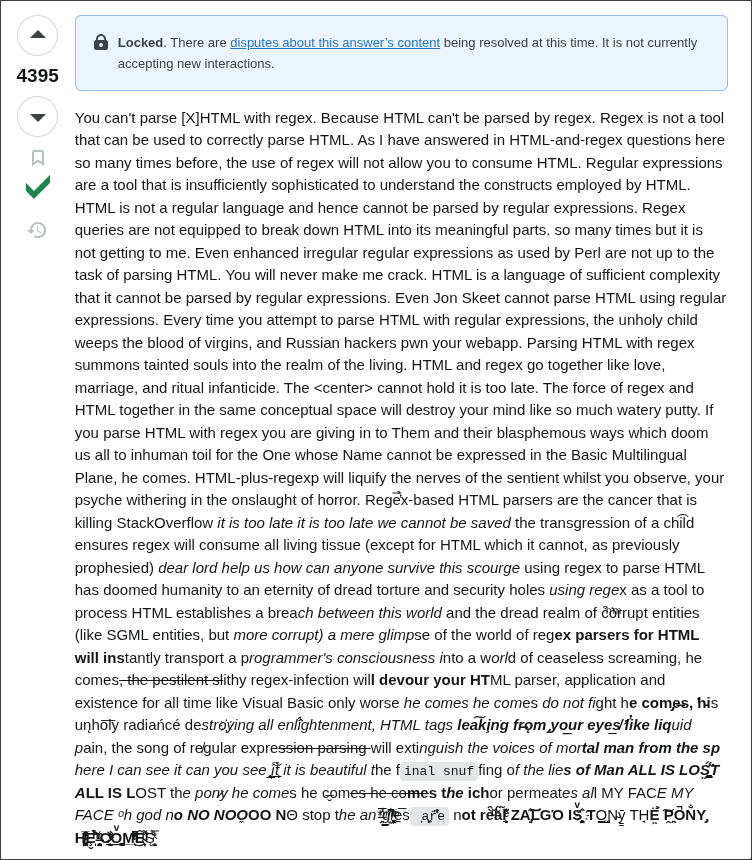
Regex queries are not equipped to break down HTML into its meaningful parts

Anyway, regex gets a bad rep. People have built horrendous things with it yes, and yes, if misused, it looks like you smashed your head against the keyboard. Still, it’s a good tool for parsing everyday strings, and perhaps more commonly, performing string validation. Of course if you need heavyweight parsing, like when parsing a programming language into an abstract syntax tree, then these days you would use tree-sitter, or in esoteric cases, hand-roll a recursive descent parser.

But what if I told you that there’s a secret third thing — use cases that are kind of too hard to parse with regex but you’re like still doing a one-off thing so you don’t want to write a formal grammar or drag in a heavy dependency. This is the realm where bad decisions have been made — the realm of the regex abominations, the x.substring(1, x.length-1), and the .split('[').map(x => x.indexOf(']')), and many many other string slicing crimes.

Parser Combinators

For these use cases I would like to show you some functional programming magic known as “Parser Combinators”, which in my opinion are a great and ergonomic way to write those semi-complicated, one-off parsers. Any major programming language will have a ready-made parser combinator library ready to use, but for the purposes of this post we will create our own!

The most important bit is understanding this type definition — the partial parser:

type Parser<T> = (input: string) => [T, string]

What’s it do? Parser<T> is a function that takes a string, consumes a part of the front of the string and turns that into a parsed value of type T; in the second entry of the tuple, we return the rest of the string.

Here’s a very simple parser, parsing an exact string:

const pHello: Parser<string> = (input: string) => {
  if (!input.startsWith("Hello"))
    throw new Error();
    
  return ["Hello", input.substring(5)];
}

Using it is simple too:

const input = "Hello, world!";
pHello(input); // ["Hello", ", world!"]

const input2 = "Hola, world!";
pHello(input2); // Error ;c

Congratulations, we’ve built a partial parser! It parses (or validates) that the input string starts with “Hello”.

It is no doubt easy to see where we are headed just from this initial example — we can take “the rest of the string” and pipe that into another partial parser to build a “parser-chain” returning many different tokens.

Instead of writing a parser function for every single string though, lets put our friend regex to use — we can use it to consume arbitrary things from the front of our input string. It would be a waste not to do that, that’s what regex is really good at!

For completeness let’s create a less general pString function aswell, that matches constant strings.

const pRegex = (regex: RegExp): Parser<string> =>
  (input: string) => {
     const match = input.match(regex);
     if (match == null) throw new Error();
     return [match[0], input.substring(match[0].length)];
   }

const pStringOfDigits = pRegex(/^\d+/);

const input3 = "420 world!";
pStringOfDigits(input3); // ["420", " world!"]

const pString = (match: string): Parser<string> =>
  (input: string) => {
    if(!input.startsWith(match))
      throw new Error();
    return [match, input.substring(match.length)];
  };

const input4 = "Hello world";
pString("Hello")(input4); //  ["Hello", " world"]

Already we are getting more functional, as here we have functions that return functions. To get the OOP folks on board we could perhaps call them parser factories or something.

Anyway, while that’s cool and all, the real power of parser combinators… it comes from the combinating and the chaining, so lets try to chain some of these parsers, and then lets see if we can generalize this somehow.

const input = "Hello 420";

const pHello = pString("Hello");
const pWhitespace = pRegex(/^\s+/);
const pStringOfDigits = pRegex(/^\d+/);

const [token1, input2] = pHello(input);
const [token2, input3] = pWhitespace(input2);
const [token3, input4] = pStringOfDigits(input3);

console.log(token1, token2, token3); // "Hello", " ", "420"
console.log(input4); // empty!

Ok.. so to apply parsers in sequence we collect all the first entries of the result tuple into a list, and the remainder goes into the next parser.

If this feels somehow related to .reduce in typescript then you have good instincts, and if it does not then I will think no less of you (maybe I will silently judge you in private). What we are doing here is actually the exact opposite of a reduction — instead of combining two values into one, we are splitting one into two. In funtional circles we call this an unfold.

But I digress, lets turn our “apply a sequence of parsers” pattern into a generic function. When variadic arguments are involved the types always get a bit funky, but I think it’s really cool that typescript is strong enough to express these types at all!

type Parsers<T extends unknown[]> = { [K in keyof T]: Parser<T[K]> };

const pSeq = <T extends unknown[]>(...parsers: Parsers<T>): Parser<T> =>
  (input) => {
    const results = [] as unknown as T;
    let rest = input;
    for (const p of parsers) {
      const [val, next] = (p as Parser<unknown>)(rest);
      results.push(val);
      rest = next;
    }
    return [results, rest];
  };

And then:

const parser = pSeq(
  pHello,
  pWhitespace,
  pStringOfDigits
);

parser("Hello 420"); // [["Hello", " ", "420"], ""];

Isn’t that neat?

We should really take a step back to admire that pSeq is a function that takes three functions (And those functions were in turn generated by a function returning functions), and it returns a function, taking a string. Proper functional madness!

One thing we would probably like to do is to have parsers returning things other than strings — usually when parsing, the goal is to get away from string representations and into more structured data after all. Of course when hand-rolling a parser function like pHello you can return whatever you want, but let’s leverage our existing infrastructure and just map over existing regex and string parsers instead, using another combinator!

const pMap = <T, R>(parser: Parser<T>, fn: (value: T) => R): Parser<R> =>
  (input: string) => {
    const [token, rest] = parser(input);
    return [fn(token), rest];
  };

const pInteger = pMap(
  pRegex(/^\d+/),
  (n: string) => Number(n)
);

pInteger("420"); // [420, ""];

Simple as that! The fact that we can map over parsers like that makes our type Parser<T> “functorial” which probably means nothing to you but it does make me all giddy. Rarely outside of academia do you get such a density of functional concepts in one place, which is why I think parser combinators are so fascinating!

A practical example

Given just those two combinators pSeq and pMap we can build pretty powerful parsers!

For a more practical example I’ve pinged 1.1.1.1 to get the following output in my terminal:

PING 1.1.1.1 (1.1.1.1) 56(84) bytes of data.
64 bytes from 1.1.1.1: icmp_seq=1 ttl=52 time=389 ms
64 bytes from 1.1.1.1: icmp_seq=2 ttl=52 time=68.7 ms
64 bytes from 1.1.1.1: icmp_seq=3 ttl=52 time=47.1 ms
64 bytes from 1.1.1.1: icmp_seq=4 ttl=52 time=48.6 ms
64 bytes from 1.1.1.1: icmp_seq=5 ttl=52 time=85.8 ms
64 bytes from 1.1.1.1: icmp_seq=6 ttl=52 time=84.8 ms
64 bytes from 1.1.1.1: icmp_seq=7 ttl=52 time=87.4 ms
--- 1.1.1.1 ping statistics ---
8 packets transmitted, 7 received, 12.5% packet loss, time 7008ms
rtt min/avg/max/mdev = 47.129/115.880/388.750/112.515 ms

Lets say we want to turn this text into useful structural data. Perhaps this can be our target type:

type IcmpPacket = {
  byteCount: number;
  from: string;
  seq: number;
  ttl: number;
  time: number;
};

type PingHeader = {
  targetIp: string; // 1.1.1.1
  resolvedIp: string; // 1.1.1.1 but in parentheses
  icmpPayloadSize: number; // 56
  totalPacketSize: number; // 84
};

type PingStatistics = {
  packetsTransmitted: number;
  packetsRecieved: number;
  packetLoss: number;
  time: number;
  rtt: {
    min: number;
    avg: number;
    max: number;
    mdev: number;
  }
};

type PingResult = {
  header: PingHeader;
  packets: IcmpPacket[];
  statistics: PingStatistics;
};

Ok — let’s try to get from A to B then. The first line should be easy right, it’s just some pSeq of parsers and then a pMap to finagle it into PingHeader shape.

const pByte = pMap(
  pInteger,
  n => {
    if (n < 0 || n > 255) throw new Error();
    return n;
  }
);
const pDot = pString(".");

const pIpV4Address = pMap(
  pSeq(pByte, pDot, pByte, pDot, pByte, pDot, pByte),
  parts => parts.join(""),
);

const pWhitespace = pRegex(/^\s+/);
const pOptionalWhitespace = pRegex(/^\s*/);

const pPingHeaderParts = pSeq(
  pString("PING"),
  pWhitespace,
  pIpV4Address,
  pWhitespace,
  pString("("),
  pIpV4Address,
  pString(")"),
  pWhitespace,
  pInteger,
  pString("("),
  pInteger,
  pString(")"),
  pString(" bytes of data."),
  pOptionalWhitespace
);

const pPingHeader = pMap(
  pPingHeaderParts,
  ([a, b, c, d, e, f, g, h, i, j, k, l, m]) => ({
    targetIp: c,
    resolvedIp: f,
    icmpPayloadSize: i,
    totalPacketSize: k
  })
);

Next, the packets! Here we have to parse a floating point number (“84.2 ms”) but apart from that it’s much the same.

const pFloat = pMap(
  pRegex(/^\d+\.?\d*/),
  Number
);

const pIcmpPacketParts = pSeq(
  pInteger,
  pString(" bytes from "),
  pIpV4Address,
  pString(": icmp_seq="),
  pInteger,
  pString(" ttl="),
  pInteger,
  pString(" time="),
  pFloat,
  pString(" ms"),
  pOptionalWhitespace
);

const pIcmpPacket = pMap(
  pIcmpPacketParts,
  ([a, b, c, d, e, f, g, h, i]) => ({
    byteCount: a,
    from: c,
    seq: e,
    ttl: g,
    time: i
  })
);

Good, and lastly, the statistics.

const pUselessLine = pRegex(/^---[^\n]+---\s*/);
const pStatsLine1 = pSeq(
  pInteger,
  pString(" packets transmitted, "),
  pInteger,
  pString(" received, "),
  pFloat,
  pString("% packet loss, time "),
  pInteger,
  pString("ms"),
  pOptionalWhitespace
);

const pStatsLine2 = pSeq(
  pString("rtt min/avg/max/mdev = "),
  pFloat,
  pString("/"),
  pFloat,
  pString("/"),
  pFloat,
  pString("/"),
  pFloat,
  pString(" ms"),
  pOptionalWhitespace
);

const pPingStatisticsParts = pSeq(
  pUselessLine,
  pStatsLine1,
  pStatsLine2
);

const pPingStatistics = pMap(
  pPingStatisticsParts,
  ([
    _,
    [a, b, c, d, e, f, g, h],
    [i, j, k, l, m, n, o, p, q],
  ]) => ({
    packetsTransmitted: a,
    packetsRecieved: c,
    packetLoss: e,
    time: g,
    rtt: {
      min: j,
      avg: l,
      max: n,
      mdev: p
    }
  })
);

Is it kind of weird that I’m using single letter variable names from a through q? Yes, but I’m really trying to push out the quickest and dirtiest parser here — in production you’d pick more sensible intermediate representations.

Anyway, we’ve got the three main sections assembled — time to build the entire thing! Since the list of packets is variable length, we’ll need a pRepeat parser that continuously applies a parser until it can’t — similarly to * in regex.

* is actually called the Kleene Star, after Stephen Kleene, in case you didn’t know.

const pRepeat = <T>(parser: Parser<T>): Parser<T[]> => 
  (input: string) => {
    const parts: T[] = [];
    let next = input;
    
    while (next.length > 0) {
      try {
        const [token, rest] = parser(next);
        next = rest;
        parts.push(token);
      } catch (e) {
        break;
      }
    }
    
    return [parts, next];
  };

const pPingParts = pSeq(
  pPingHeader,
  pRepeat(pIcmpPacket),
  pPingStatistics 
);

const pPingSummary: Parser<PingSummary> = pMap(
  pPingParts,
  ([header, packets, statistics]) => ({
    header, packets, statistics
  })
);

And there you go! I even annotated the last parser’s type as a little victory celebration.

In a single blog post, we built up a very complicated parser from literally zero, and we even came up with a hand-rolled parser combinator library along the way!

Of course as mentioned earlier, usually you wouldn’t have to write the combinators yourself, javascript for example has the parsimmon library which has been getting some traction in recent years. Other than the combinators which might need some brainpower, the writing of the parser itself is super straight-forward, wouldn’t you say?

It’s much easier to create correct parsers with these things than with a regex; especially once you start nesting pSeq calls and such, the equivalent regex would just become an unreadable mess, while the parser combinator approach resulted in a squeaky clean parser!

Go give parser combinators a try next time you have to parse something, in my opinion it’s a really elegant solution to the parser problem.