Type Systems #13: The Typescript Lattice
(This is part 13 in a series on type systems. You can find part 12 here .)
On the thirteenth day of christmas, my true love gave to me… a typescript type diagram, tee hee!
Here is a non-exhaustive diagram of types that exist in typescript, and their subtypes.
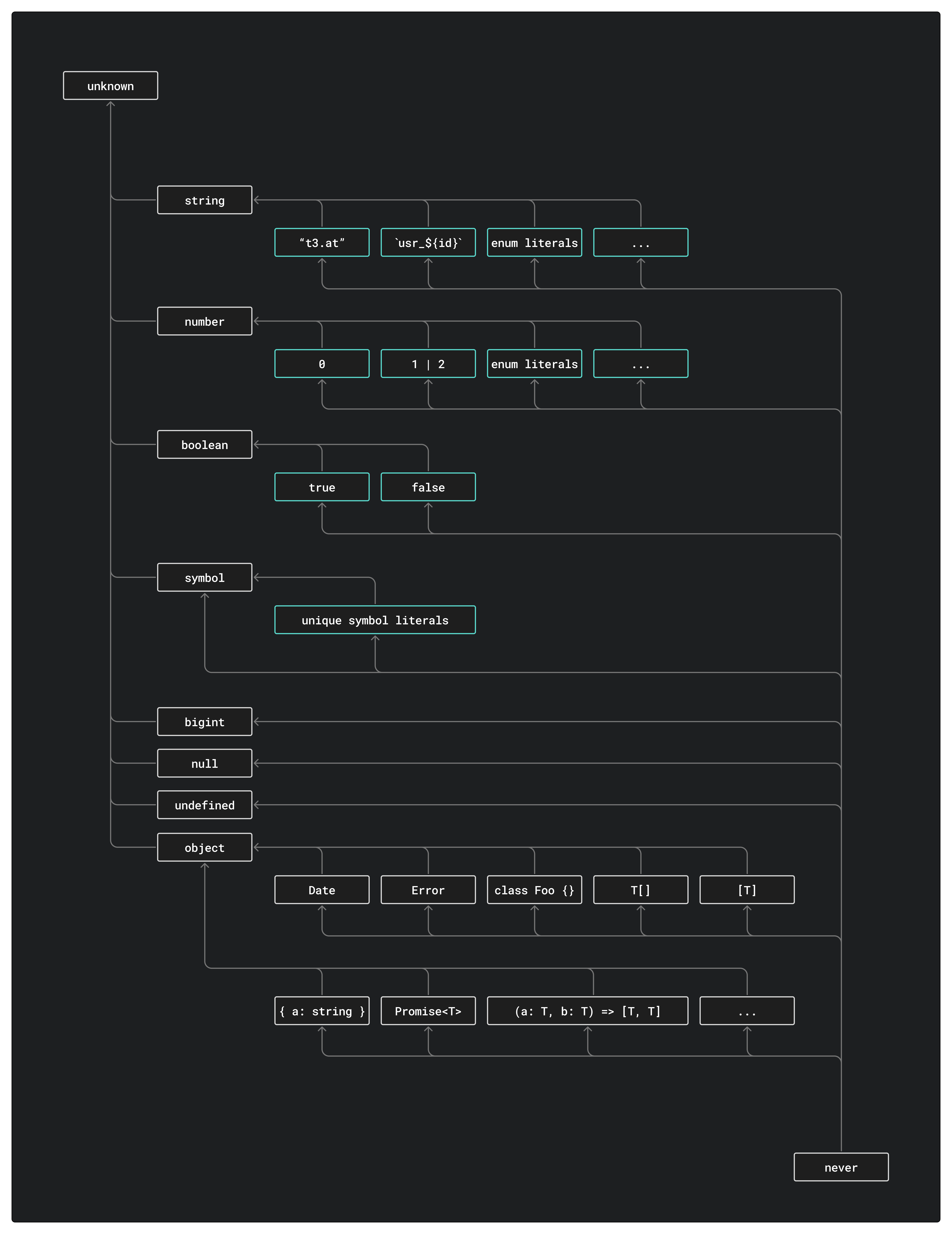
Arrows represent a subtype relationship — so for example, 1 is a subtype of number, and number
is a subtype of unknown. Teal squares represent literal types — as many of you will know, 0 is not
only a value, but also a type in typescript, which is one of typescript’s cooler features.
Roughly we can categorize types in typescript into the “primitives”, like string, number,
and “reference types”, like objects and arrays and functions.
Especially notable is unknown, which is the supertype of all types, and never, which is
the subtype of all types. This is not something that we think about in day-to-day programming,
but it’s true: the function const foo = <T extends unknown>(x: T) => {} and const foo = <T>(x: T) => {}
are the same — since everything inherits from unknown anyway, it’s redundant to specify it.
never is typically used to denote dead code paths, or impossible types, so it maybe seems odd to
call it a subtype of all types. For now the only justification I will give is “in typescript it’s true”,
meaning if you have const foo = <T extends number>(x: T) => {}, you can indeed call foo with a value of type never.
You’ll have a hard time finding a value of type never, but your code will typecheck just fine.
Oh yeah. And then there’s any.

It’s simultaneously the subtype and supertype of all types, which pretty much ruins any
mathematical framework we can establish, and breaks many nice mathematical
properties. any is more like an escape hatch that disables type checking
though, so it’s not really meant to be used in the same way as other types
and we choose to ignore it whenever convenient.
Hope that’s okay!
(This is part 13 in a series on type systems. You can find part 14 here .)